
The story of the Kohinoor diamond has fascinated historians, emperors, scientists, and gem lovers for centuries. Known as one of the world’s most famous diamonds, the Kohinoor carries a rich legacy of power, conquest, royalty, and mystery. Yet one question has continued to puzzle researchers for generations: where did such an extraordinary diamond actually come from?
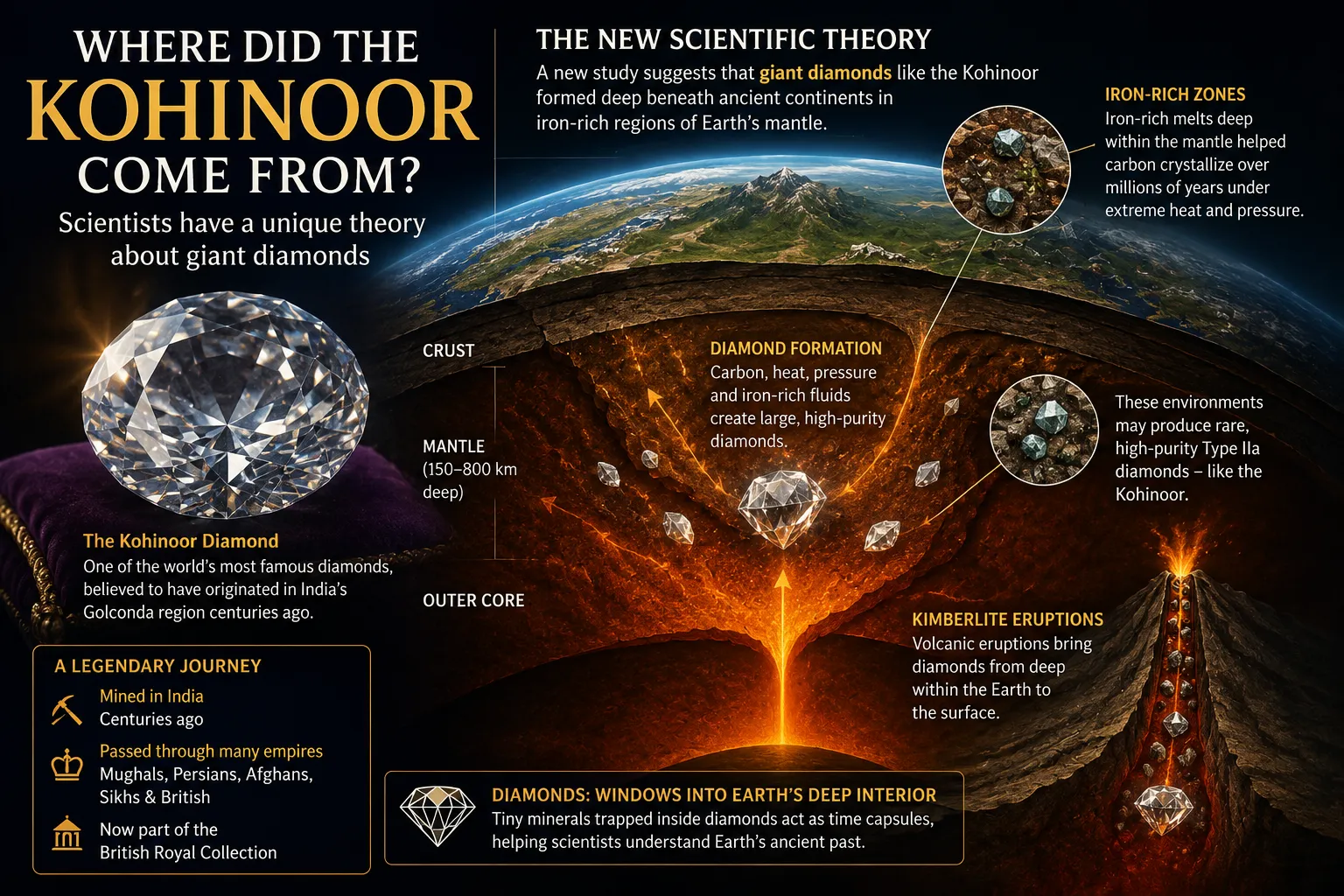
Now, scientists believe they may finally be closer to an answer. A new geological theory suggests that giant diamonds like the Kohinoor formed deep beneath ancient continents in iron-rich regions of Earth’s mantle. The findings are helping researchers understand not only how massive diamonds were created, but also why these rare gems are so different from ordinary diamonds found in jewelry stores.
The discovery could reshape modern understanding of diamond formation and even help geologists locate future diamond deposits hidden deep underground.
The Kohinoor: A Diamond Surrounded by History
The Kohinoor, whose name means “Mountain of Light,” is believed to have originated in India’s Golconda region, famous for producing some of the finest diamonds in history. Historians estimate the diamond was mined centuries ago from the Kollur Mine in present-day Andhra Pradesh.
Over time, the Kohinoor passed through the hands of several rulers and empires, including the Mughals, Persians, Afghans, Sikhs, and eventually the British Crown. Today, it remains part of the British royal collection and continues to spark political and historical debate.
What makes the Kohinoor even more fascinating is its unusual purity and size. Scientists have long wondered how such exceptionally large diamonds could form naturally inside Earth under extreme geological conditions.
Recent research may now provide the missing piece of that puzzle.
Scientists Discover a New Clue About Giant Diamonds
A recent scientific study suggests that giant diamonds formed in highly iron-rich zones located deep beneath stable continental regions called cratons. Cratons are ancient parts of Earth’s crust that have survived for billions of years and contain some of the planet’s oldest rocks.
Researchers found evidence that iron-rich melts deep inside Earth may have played a critical role in creating unusually large and high-purity diamonds. These conditions likely existed hundreds of kilometers below the surface under immense heat and pressure.
Unlike ordinary diamonds, giant diamonds appear to form in unique chemical environments where iron, carbon, and deep mantle materials interact over millions or even billions of years.
Scientists believe these deep-Earth processes helped create famous diamonds such as the Kohinoor, Cullinan, and other historic gems.
How Diamonds Actually Form Beneath Earth
Many people still believe the popular myth that diamonds come from coal. Geologists, however, say this is incorrect. Most natural diamonds form deep within Earth’s mantle — far below where coal deposits exist.
Diamonds typically form at depths of around 150 to 250 kilometers beneath the surface. There, carbon atoms experience enormous pressure and temperatures exceeding 1,000 degrees Celsius. Under these extreme conditions, carbon crystallizes into diamonds.
However, giant diamonds appear to originate even deeper in the mantle. Scientists refer to some of them as “superdeep diamonds” because they form between 250 and 800 kilometers below Earth’s surface.
These rare diamonds often contain tiny mineral inclusions trapped during formation. Those microscopic inclusions act like time capsules, helping researchers study Earth’s deep interior.
Why Iron-Rich Regions Matter
The newest research focuses on the role of iron-rich mantle zones in diamond formation. Scientists discovered traces of iron carbides and metallic inclusions inside certain large diamonds, suggesting that molten iron may have been involved in the growth process.
Researchers believe iron-rich fluids may help carbon crystallize more efficiently under deep mantle conditions. This could explain why some diamonds grow exceptionally large and maintain remarkable clarity.
According to geologists, these iron-rich environments likely existed beneath ancient continental regions that remained stable for billions of years. Such conditions provided enough time and pressure for massive diamonds to slowly develop.The findings are important because they challenge older theories that focused mainly on temperature and pressure while overlooking the role of mantle chemistry.
What Makes Giant Diamonds Different From Regular Diamonds
Not all diamonds are created equally. Most commercial diamonds are relatively small and contain imperfections or traces of other minerals. Giant diamonds, however, are exceptionally rare.
Famous diamonds like the Kohinoor are classified as Type IIa diamonds, known for their extraordinary purity. These diamonds contain extremely low levels of nitrogen and other impurities, making them chemically unique.
Scientists now believe that this purity may be connected to the special iron-rich environments where these gems formed deep underground.Because of their unusual origin, giant diamonds can provide valuable scientific information about Earth’s mantle and geological history.Researchers often study these gems not only for their beauty, but also because they offer a rare glimpse into regions of Earth humans can never directly access.
Diamonds as Windows Into Earth’s Interior
One of the most exciting parts of modern diamond research is how these gemstones help scientists study Earth’s hidden interior.Tiny inclusions trapped inside diamonds preserve minerals from deep within the mantle. By analyzing these microscopic materials, researchers can learn about the temperature, pressure, and chemical composition of Earth billions of years ago.
Some superdeep diamonds have even revealed evidence of ancient oceanic crust being recycled deep into the mantle through tectonic plate movement.
Others contain minerals that can only form under extreme pressures found hundreds of kilometers below the surface.In many ways, diamonds function like natural geological archives, carrying scientific evidence from parts of Earth that are otherwise unreachable.
The Role of Kimberlite Eruptions
Even after diamonds form deep underground, they still need a way to reach Earth’s surface. This happens through rare volcanic eruptions known as kimberlite eruptions.
Kimberlite magma rises extremely quickly from deep within Earth, carrying diamonds along with it before the gems can melt or break apart.
Scientists believe these eruptions may be linked to the breakup of ancient supercontinents. Some recent studies suggest that powerful mantle plumes — giant columns of hot material rising from deep within Earth — may trigger these explosive eruptions.Without kimberlite eruptions, diamonds like the Kohinoor would likely remain permanently buried deep inside the planet.
Could This Research Help Find New Diamonds?
The findings may also have practical value for modern diamond exploration.
If giant diamonds form in iron-rich mantle regions beneath ancient cratons, geologists can use this information to better identify promising mining locations. Understanding the chemistry and geological history of diamond-forming regions could improve future exploration efforts.
Scientists say the research may help explain why certain regions consistently produce large, high-quality diamonds while others do not.This could eventually reduce exploration costs and improve the accuracy of geological surveys.
The Kohinoor’s Mystery Continues
Although the new theory offers exciting clues, scientists still do not know every detail about how the Kohinoor formed. The diamond’s exact geological journey remains partly hidden beneath millions of years of Earth’s history.
Still, the latest discoveries bring researchers closer to understanding the extraordinary natural processes that created one of the world’s most legendary gems.
The Kohinoor is no longer just a symbol of royal history and political controversy. It is also becoming a scientific treasure — one that may reveal secrets about Earth’s deep interior, ancient continents, and the incredible forces shaping our planet long before human civilization existed.
As research continues, giant diamonds may help scientists uncover even more mysteries hidden beneath Earth’s surface. And in the process, the Kohinoor’s story becomes not only a tale of kings and empires, but also one of geology, deep time, and the astonishing power of nature.
releaseprcore.com releaseprcore.com releaseprcore.com releaseprcore.com releaseprcore.com releaseprcore.com releaseprcore.com releaseprcore.com releaseprcore.com releaseprcore.com releaseprcore.com releaseprcore.com releaseprcore.com releaseprcore.com releaseprcore.com releaseprcore.com releaseprcore.com releaseprcore.com releaseprcore.com releaseprcore.com releaseprcore.com releaseprcore.com releaseprcore.com releaseprcore.com releaseprcore.com releaseprcore.com releaseprcore.com releaseprcore.com releaseprcore.com releaseprcore.com releaseprcore.com releaseprcore.com releaseprcore.com releaseprcore.com releaseprcore.com releaseprcore.com releaseprcore.com releaseprcore.com releaseprcore.com releaseprcore.com releaseprcore.com releaseprcore.com releaseprcore.com releaseprcore.com releaseprcore.com releaseprcore.com releaseprcore.com releaseprcore.com releaseprcore.com releaseprcore.com releaseprcore.com releaseprcore.com releaseprcore.com releaseprcore.com releaseprcore.com releaseprcore.com releaseprcore.com releaseprcore.com releaseprcore.com releaseprcore.com releaseprcore.com releaseprcore.com releaseprcore.com releaseprcore.com releaseprcore.com releaseprcore.com releaseprcore.com releaseprcore.com releaseprcore.com releaseprcore.com releaseprcore.com releaseprcore.com releaseprcore.com releaseprcore.com releaseprcore.com releaseprcore.com releaseprcore.com releaseprcore.com releaseprcore.com releaseprcore.com releaseprcore.com releaseprcore.com releaseprcore.com releaseprcore.com releaseprcore.com releaseprcore.com releaseprcore.com releaseprcore.com releaseprcore.com releaseprcore.com releaseprcore.com releaseprcore.com releaseprcore.com releaseprcore.com releaseprcore.com releaseprcore.com releaseprcore.com releaseprcore.com releaseprcore.com releaseprcore.com releaseprcore.com releaseprcore.com releaseprcore.com releaseprcore.com releaseprcore.com releaseprcore.com releaseprcore.com releaseprcore.com releaseprcore.com releaseprcore.com releaseprcore.com releaseprcore.com releaseprcore.com releaseprcore.com releaseprcore.com releaseprcore.com releaseprcore.com releaseprcore.com releaseprcore.com releaseprcore.com releaseprcore.com releaseprcore.com releaseprcore.com releaseprcore.com releaseprcore.com releaseprcore.com releaseprcore.com releaseprcore.com releaseprcore.com releaseprcore.com releaseprcore.com releaseprcore.com releaseprcore.com releaseprcore.com releaseprcore.com releaseprcore.com releaseprcore.com releaseprcore.com releaseprcore.com releaseprcore.com releaseprcore.com releaseprcore.com releaseprcore.com releaseprcore.com releaseprcore.com releaseprcore.com releaseprcore.com releaseprcore.com releaseprcore.com releaseprcore.com releaseprcore.com releaseprcore.com releaseprcore.com releaseprcore.com releaseprcore.com releaseprcore.com releaseprcore.com releaseprcore.com releaseprcore.com releaseprcore.com releaseprcore.com releaseprcore.com releaseprcore.com releaseprcore.com releaseprcore.com releaseprcore.com releaseprcore.com