
The African continent, long known for its dramatic geological activity along the East African Rift System, is showing fresh signs of extension in its southwestern regions. Scientists have detected mantle-derived helium signatures in hot springs along Zambia’s Kafue Rift, providing compelling geochemical evidence that the Southwest African Rift Zone is tectonically active. This discovery suggests the early stages of continental rifting that could, over millions of years, contribute to the further breakup of sub-Saharan Africa.
The findings come from a detailed study of hydrothermal springs in the Kafue Rift, a segment of a broader extensional zone linking the East African Rift System through central Africa toward Namibia. Researchers measured helium isotope ratios in gases from these springs that are significantly higher than typical crustal values but consistent with a mantle contribution. In contrast, springs outside the rift boundary faults showed purely crustal signatures, highlighting that mantle fluid upwelling is focused along the active fault zones.
These elevated helium ratios, accompanied by carbon isotope values close to mantle ranges, indicate a direct fluid connection from the Earth’s mantle, located tens of kilometers below the surface, to the surface hot springs. High concentrations of crustal nitrogen and elevated helium further support the mobilization of deep fluids along crustal-scale faults. The presence of mantle helium without significant recent volcanism points to tectonic stretching creating permeable pathways, a hallmark of incipient rifting.
Understanding the Southwest African Rift Zone
While the East African Rift System is well-studied—with the African Plate splitting into the Nubian and Somali Plates at rates of about 7–8 millimeters per year—the southwestern extension has received less attention until now. The Kafue Rift forms part of a broader zone of extension that connects northward to the Malawi and Luangwa Rifts and extends southwestward. This system represents a potential new plate boundary developing across southern Africa.
The geochemical data from Zambia closely resemble patterns observed in the early stages of rifting within the East African Rift System, such as in areas with limited magmatic activity but clear tectonic strain. Low-level seismicity along the faults, combined with the mantle fluid signatures, supports the interpretation of active lithospheric thinning. If similar anomalies are confirmed along adjacent segments, it would strengthen the case for a continuous, emerging plate boundary capable of eventual continental separation.
This process mirrors how continents have broken apart in the past. The same fundamental forces that once separated South America from Africa to form the South Atlantic are at work today, albeit at a much earlier stage in this region. A superplume of hot rock rising from deep within the Earth is thought to drive much of the broader African rifting, weakening the lithosphere and facilitating extension.
Implications for Geology, Resources, and Society
The discovery carries both scientific and practical significance. On a geological timescale, continued rifting could eventually lead to the formation of a new ocean basin, though this would take tens of millions of years. In the nearer term, the findings highlight geothermal energy potential along these active fault zones, where mantle heat and fluid circulation create favorable conditions for development.
The combination of mantle-derived carbon dioxide, fault-controlled fluid pathways, and groundwater interaction also suggests possibilities for exploring economically valuable gases, including helium and potentially hydrogen. Helium, in particular, is a critical resource with limited global supply, used in medical imaging, semiconductors, and scientific research. The high helium concentrations observed make these areas prospective targets.
For local communities in Zambia and neighboring regions, understanding this activity is vital for infrastructure planning, seismic risk assessment, and sustainable resource management. While the rifting poses no immediate catastrophic threat, associated earthquakes and changes in groundwater systems require monitoring. The region’s hot springs already reflect ongoing hydrothermal activity that shapes local landscapes and ecosystems.
Broader Context of Continental Rifting
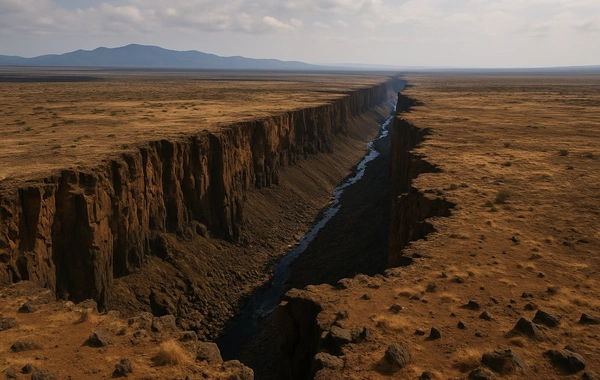
Continental rifting is one of the fundamental processes of plate tectonics. Successful rifts evolve from continental extension through narrow rifts and eventually to oceanic spreading centers. The East African Rift provides a live laboratory for studying this progression, from the Afar Triangle in the north—where seafloor spreading is beginning—to more mature segments and now potentially the southwestern frontiers.
In Zambia’s case, the absence of widespread surface volcanism distinguishes it from more advanced eastern rift segments. This “dry” or magma-poor style of rifting relies more on mechanical stretching than magmatic weakening, though the helium data confirm that mantle connections exist. Such observations refine global models of how continents break up and help predict where new ocean basins might eventually form.
The Kafue findings also underscore the importance of noble gas geochemistry as a tool for detecting hidden tectonic activity. Helium isotopes act as powerful tracers because they preserve signatures of their deep origins: elevated ratios flag mantle input that is otherwise difficult to detect without direct volcanic activity.
Looking Ahead
As research continues, scientists will seek to map the full extent of this southwestern rift zone through additional geochemical sampling, geophysical surveys, and seismic monitoring. Confirming mantle connectivity across a wider area would mark a significant advance in understanding Africa’s tectonic future.
Africa’s slow-motion breakup serves as a powerful reminder of our planet’s dynamic nature. What appears as stable landmasses on human timescales is, in geological terms, constantly reshaping. The hot springs of the Kafue Rift, quietly releasing ancient mantle gases, offer a tangible link to processes that will one day redraw the map of southern Africa.
For now, this discovery enriches our knowledge of how continents rift and opens new avenues for sustainable energy and resource exploration. It also invites awe at the immense forces operating beneath our feet—forces that, bubble by bubble in a Zambian hot spring, signal the continent’s ongoing evolution.
socialmedixy socialmedixy socialmedixy socialmedixy socialmedixy socialmedixy socialmedixy socialmedixy socialmedixy socialmedixy socialmedixy socialmedixy socialmedixy socialmedixy socialmedixy socialmedixy socialmedixy socialmedixy socialmedixy socialmedixy socialmedixy socialmedixy socialmedixy socialmedixy socialmedixy socialmedixy socialmedixy socialmedixy socialmedixy socialmedixy socialmedixy socialmedixy socialmedixy socialmedixy socialmedixy socialmedixy socialmedixy socialmedixy socialmedixy socialmedixy socialmedixy socialmedixy socialmedixy socialmedixy socialmedixy socialmedixy socialmedixy socialmedixy socialmedixy socialmedixy socialmedixy socialmedixy socialmedixy socialmedixy socialmedixy socialmedixy socialmedixy socialmedixy socialmedixy socialmedixy socialmedixy socialmedixy socialmedixy socialmedixy socialmedixy socialmedixy socialmedixy socialmedixy socialmedixy socialmedixy socialmedixy socialmedixy socialmedixy socialmedixy socialmedixy socialmedixy socialmedixy socialmedixy socialmedixy socialmedixy socialmedixy socialmedixy socialmedixy socialmedixy socialmedixy socialmedixy socialmedixy socialmedixy socialmedixy socialmedixy socialmedixy socialmedixy socialmedixy socialmedixy socialmedixy socialmedixy socialmedixy socialmedixy socialmedixy socialmedixy socialmedixy socialmedixy socialmedixy socialmedixy socialmedixy socialmedixy socialmedixy socialmedixy socialmedixy socialmedixy socialmedixy socialmedixy socialmedixy socialmedixy socialmedixy socialmedixy socialmedixy socialmedixy socialmedixy socialmedixy socialmedixy socialmedixy socialmedixy socialmedixy socialmedixy socialmedixy socialmedixy socialmedixy socialmedixy socialmedixy socialmedixy socialmedixy socialmedixy socialmedixy socialmedixy socialmedixy socialmedixy socialmedixy socialmedixy socialmedixy socialmedixy socialmedixy socialmedixy socialmedixy socialmedixy socialmedixy socialmedixy socialmedixy socialmedixy socialmedixy socialmedixy socialmedixy socialmedixy socialmedixy socialmedixy socialmedixy socialmedixy socialmedixy socialmedixy socialmedixy socialmedixy socialmedixy socialmedixy socialmedixy socialmedixy socialmedixy socialmedixy