
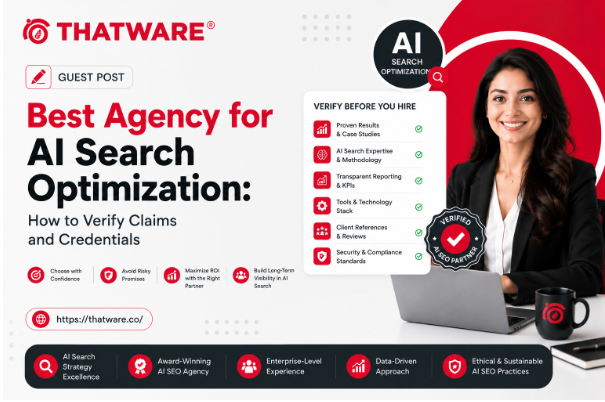
The agency pitch for AI search optimization can be genuinely impressive. Sophisticated-sounding methodology. Impressive case study numbers. A team page full of people with AI and machine learning in their bios. A demo of some proprietary platform that generates reports with lots of graphs.
None of that tells you whether the agency can actually do what they’re claiming. The field is young enough that credentials are inconsistent, case studies are self-selected, and the terminology is loosely defined enough to accommodate a wide range of actual capabilities behind similar-sounding pitches.
So how do you verify, rather than just trust?
Why Verification Matters More in AI Search Optimization
In traditional SEO, verification is straightforward in principle: you can look at their clients’ rankings, traffic trends, and link profiles through publicly available tools. The outcomes are observable. If an agency says they improved a client’s traffic by 200%, you can roughly validate that through SimilarWeb or SEMrush data.
AI search optimization is harder to independently verify. Semantic authority improvements are less directly observable from the outside. AI Overview visibility isn’t tracked by most public tools. Probabilistic intent modeling is a proprietary methodology that can’t be audited through third-party software. And the timelines are long enough that it’s difficult to attribute organic improvements specifically to the agency’s work versus general market trends.
This creates an information asymmetry that agencies can exploit — either deliberately or unconsciously — and that buyers need to actively work to close.
Step One: Audit the Case Studies Independently
When an agency presents a case study, they’re showing you their highlight reel. The question is whether the highlighted outcomes are real, significant, and attributable to the agency’s work specifically.
For any case study you’re taking seriously, do this:
Check the client company’s organic traffic through SimilarWeb, SEMrush, or Ahrefs. Does the traffic trajectory match what the case study describes? If the case study claims a 150% organic traffic increase during a specific period, that should be visible in third-party data, at least directionally.
Check for potential confounds. Did the client also relaunch their site during this period? Launch a major PR campaign? Benefit from category-level search volume growth? Organic traffic improvements have many potential causes, and a credible agency can articulate why their work specifically drove the outcomes they’re claiming.
Ask for the starting baseline. “We grew organic traffic by 200%” means something very different depending on whether the starting point was 500 visitors/month or 50,000. Specific baselines matter.
Step Two: Test the Methodology Depth
For any agency claiming to be the best agency for AI search optimization, the methodology should be specific enough to be testable. Here’s how:
Ask them to do a brief live analysis of your site — not a prepared presentation, but an on-the-spot assessment. Ask them what they observe about your current semantic entity coverage, where they see the biggest gaps, and what they’d prioritize first. Genuine AI search optimization experts will have substantive, specific answers. Agencies with thin methodology will give generic responses about “content quality” and “topical authority.”
Ask them to explain a concept you can verify. “How does probabilistic intent modeling work in practice, and can you show me an example of intent distribution analysis you’ve done?” The answer should be concrete and demonstrable, not abstract.
Ask them how they’d differentiate your organic strategy from a competitor’s. Real methodology produces differentiated approaches. Agencies with templated processes will struggle to articulate meaningful differentiation beyond surface-level things like “we’d focus on your specific keywords.”
Step Three: Verify the Team’s Actual Expertise
Agency team pages are marketing materials. The people listed may or may not be the people who’d actually work on your account. Verify a few things:
Ask who specifically would work on your account — by name — and ask to speak with those people before signing. If the agency is reluctant to provide access to the actual practitioners before a contract is signed, be cautious.
Check the LinkedIn profiles of the team members you’d be working with. Do their backgrounds actually include AI, machine learning, or advanced SEO methodology? Or are they primarily content writers and account managers with “AI SEO” added to their titles recently?
Ask about continuing education and staying current. AI search optimization is evolving fast. How does the team keep up with changes in LLM behavior, algorithm updates, and emerging GEO methodology? The answer tells you something about the agency’s learning culture.
Step Four: Reference Checks Done Right
References are useful only if you ask the right questions. The questions that agencies expect: “Were you happy with the results?” “Would you recommend them?” These get positive answers almost by default — people refer to their reasonably good experiences and avoid referring to their bad ones.
The questions that actually reveal things: “What did they get wrong or underestimate in the first six months, and how did they handle it?” “What would you push them to do differently if you were starting the engagement over?” “Did their best AI SEO agency claims match the actual AI capability they delivered?” That last question is direct enough to produce honest answers from references who genuinely experienced the AI layer working (or not).
Red Flags That Should Stop the Conversation
Certain things should prompt serious caution regardless of how good the rest of the pitch is:
Guarantees on AI Overview visibility or specific LLM citation frequency. Neither of these is controllable, and any guarantee is either false or deliberately misleading.
Proprietary “AI platform” that turns out to be a white-labeled third-party tool with a branded interface. Ask directly: “Is your platform proprietary, or is it built on another tool?”
Inability to explain what specific signals they optimize for in AI search contexts. If the answer is “we focus on high-quality content,” that’s not an AI search optimization methodology.
Reluctance to provide references who specifically experienced AI search optimization outcomes, as opposed to general SEO results.
Verification is work. It takes time and requires asking uncomfortable questions in sales contexts. But for a service where methodology is difficult to observe from the outside and the returns unfold over many months, the verification investment upfront is worth significantly more than discovering the gap six months in.