
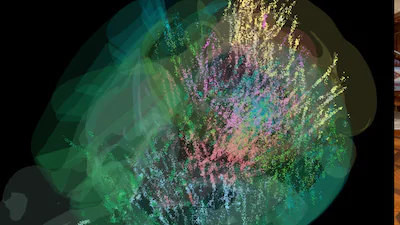
Have you ever wondered what happens in your brain when you make a decision — even a small one, like choosing which button to press? A group of scientists has taken a big step toward answering that question. They recorded the activity of more than 600,000 neurons (brain cells) across nearly the entire mouse brain while the animals made decisions.
This study is the largest brain activity map ever created and shows that making a decision is not handled by just one part of the brain, but by many regions working together in sync.
How the Scientists Did It
This research was carried out by the International Brain Laboratory (IBL), which includes 22 labs working together around the world. The project lasted about seven years and used 139 mice to gather a huge amount of data.
-
Special recording tools: The team used Neuropixels probes, which are tiny devices that can record signals from thousands of neurons at the same time.
-
The task: The mice were trained to use a small steering wheel to respond to visual signals on a screen. When they moved the wheel correctly, they got sugar water as a reward.
-
Challenging tests: Sometimes, the visual signal was faint, forcing the mice to rely on memory or guesswork. This helped scientists see how the brain uses past experience (memory) to make a choice.
By recording brain activity during this task, the scientists captured data from 279 brain regions, representing about 95% of the mouse brain.
vlonehoodiestore.com | instabioguru.com | techautoshub.com
globe-wander.com | tourepicness.com
What They Found
1. Decisions Involve the Whole Brain
One of the most important findings is that decision-making is not limited to one brain area. When the mice saw the visual signal, the first brain regions to activate were those linked to vision. Then, areas that control movement became active as the mice acted. Finally, when the mice got the reward, many brain areas lit up again.
This shows that decision-making is a step-by-step process involving sight, action, and reward — but with almost the whole brain involved, not just one spot.
2. Memory Shapes Choices
When the visual signals were hard to see, the mice often guessed based on what had happened before. The recordings showed that many parts of the brain carried this “memory of the past,” including sensory and thinking areas. This proves that decision-making is influenced not just by what we see right now, but also by what we expect based on past experiences.
3. Coordinated Brain Network
The study found that most brain regions worked together in a coordinated way. This challenges old ideas that decision-making happens in only small clusters of neurons. Instead, decisions are made by large groups of neurons firing in sync across many regions at once.
Why This Study Is Important
Largest Collaboration in Neuroscience
This is one of the biggest and most organized studies ever done in brain science. All 22 labs followed the exact same procedures and shared data, creating an open dataset that other scientists can now use for more discoveries.
A New Understanding of the Brain
Older models imagined that decisions were made step by step — first sensing, then thinking, then acting. This research shows it’s more like a team effort where many parts of the brain are active at the same time.
A Tool for Future Research
Because the data is open, scientists can now use it to study:
-
How brain disorders affect decision-making.
-
Which brain regions are most important for memory and learning.
-
How to design better AI systems that work like real brains.
What Experts Say
Neuroscientist Alexandre Pouget from the University of Geneva called the project a “Sloan Digital Sky Survey for the brain” — comparing it to a famous astronomy project that mapped the stars. He hopes this will inspire more researchers to do large, shared projects like this.
Dr. Paul Glimcher from New York University said this will go down as a major milestone in neuroscience because it is the largest dataset of brain activity ever collected.
Implications for Humans
Even though this study was done on mice, many of the brain systems are similar to those in humans. The findings could help:
-
Understand mental health: Conditions like ADHD, depression, or schizophrenia affect decision-making. Knowing how the healthy brain works can guide treatments.
-
Build smarter AI: If computers can mimic how our brain makes choices, they could become better at solving complex problems.
-
Study memory and learning: This work shows exactly how memory affects decisions, which can help improve education and memory research.
Big Picture
The brain does not work like a simple switchboard. Instead, it behaves like an orchestra — with many regions playing together in perfect timing to create a decision.
This research is not the final answer but a starting point. With this map, future studies can zoom in on specific brain circuits to learn even more about how we think, choose, and act.
Summary
-
Scientists recorded signals from 600,000 neurons across 279 brain regions in mice.
-
Decision-making was found to involve almost the whole brain, not just one small area.
-
Memory and expectation strongly influence how decisions are made.
-
This is one of the largest neuroscience collaborations ever, and the data is open for further research.
-
The results may help treat brain disorders and build better AI.
This research gives us the clearest picture yet of how decisions form in the brain — from seeing something to acting on it and getting a reward. It proves that making choices is a brain-wide process, with many regions working together.